Manometers — Theory
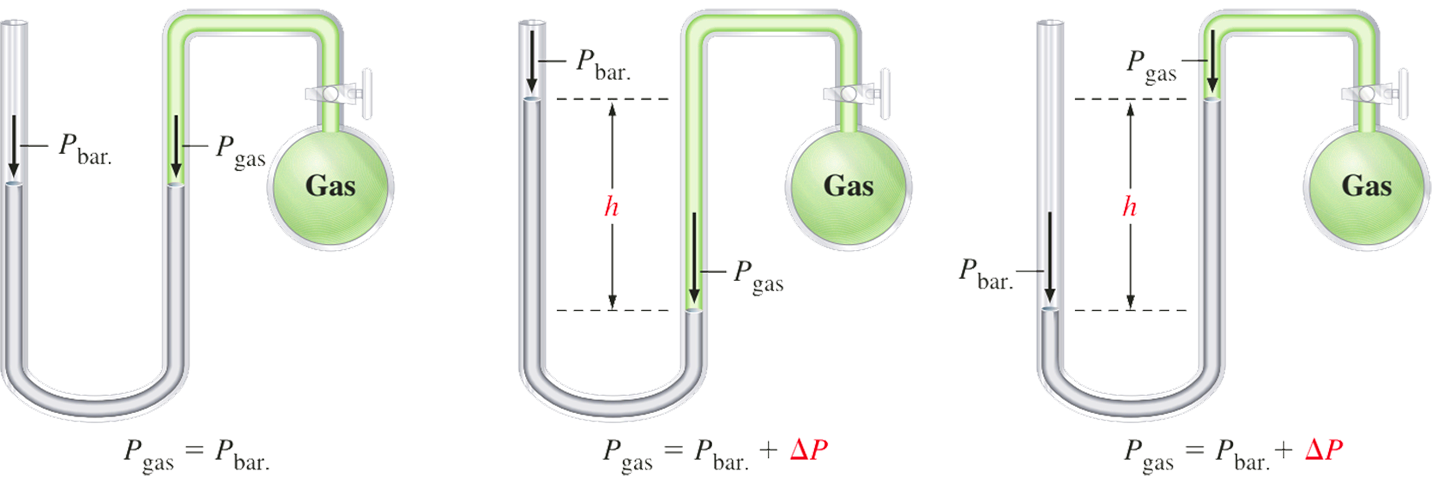
A manometer compares an unknown gas pressure with a reference pressure using a column of liquid.
Two standard setups are used:
open-end (reference = barometric pressure \(P_{\text{bar}}\)) and
closed-end (reference ≈ vacuum).
The hydrostatic relation for a vertical column is
\[
\Delta P \;=\; \rho \, g \, \Delta h
\]
- \(\rho\): liquid density (kg·m\(^{-3}\)); for mercury, \(\rho_{\mathrm{Hg}} \approx 13.5951\ \text{g·cm}^{-3}\) at \(0^\circ\)C.
- \(g\): gravitational acceleration (\(\mathrm{m\,s^{-2}}\)); standard \(9.80665\ \mathrm{m\,s^{-2}}\).
- \(\Delta h\): difference in liquid levels between the two arms (m).
Open-end manometer (compare to atmosphere)
The atmosphere acts on one limb with \(P_{\text{bar}}\); the gas acts on the other with \(P_{\text{gas}}\).
The sign depends on which side is lower/higher:
| Observation | Relation | Comment |
|---|
| Gas side lower (gas pushes harder) |
\(P_{\text{gas}} = P_{\text{bar}} + \rho g\,\Delta h\) |
\(P_{\text{gas}} > P_{\text{bar}}\) |
| Gas side higher (atmosphere pushes harder) |
\(P_{\text{gas}} = P_{\text{bar}} - \rho g\,\Delta h\) |
\(P_{\text{gas}} < P_{\text{bar}}\) |
| Levels equal |
\(P_{\text{gas}} = P_{\text{bar}}\) |
\(\Delta h = 0\) |
If the liquid is mercury and \(\Delta h\) is read in millimeters, then
\(\Delta P\) expressed in mmHg is numerically \(\approx \Delta h\) (conventional),
whereas Torr is defined exactly by \(1\ \text{atm} = 760\ \text{Torr}\).
Closed-end manometer (vacuum reference)
The sealed limb contains (nearly) vacuum; the measured pressure is absolute:
\[
P_{\text{gas}} \;=\; \rho \, g \, h
\]
Unit facts (used in the calculator)
- \(1\ \text{atm} = 101\,325\ \text{Pa}\) (exact).
- \(1\ \text{atm} = 760\ \text{Torr}\) (exact) ⇒ \(1\ \text{Torr} = \dfrac{101\,325}{760}\ \text{Pa}\).
- \(1\ \text{mmHg} \approx 133.322\ \text{Pa}\) (conventional, from \(\rho_{\mathrm{Hg}} g\)).
Worked example (open-end, like textbook Fig. 6-5c)
Given a mercury manometer with \(\Delta h = 8.6\ \text{mm}\), barometric pressure
\(P_{\text{bar}} = 748.2\ \text{mmHg}\), and the gas side is higher than the open side.
Find \(P_{\text{gas}}\).
\[
\begin{aligned}
\Delta P &\approx \Delta h = 8.6\ \mathrm{mmHg} \\
P_{\text{gas}} &= P_{\text{bar}} - \Delta P \\
&= 748.2\ \mathrm{mmHg} - 8.6\ \mathrm{mmHg} \\
&= 739.6\ \mathrm{mmHg} \\
&= \frac{739.6}{760}\ \mathrm{atm} \\
&\approx 0.973\ \mathrm{atm}
\end{aligned}
\]
Worked example (effect of a different liquid)
Keep the same pressure difference as above (\(\Delta P=8.6\ \text{mmHg}\)), but fill the manometer with
glycerol, \(\rho\_{\text{gly}} \approx 1.26\ \text{g·cm}^{-3}\).
What \(\Delta h\) (in mm of glycerol) would produce the same \(\Delta P\)?
\[
\begin{aligned}
\Delta P &= \rho_{\mathrm{Hg}} g\,\Delta h_{\mathrm{Hg}}
= \rho_{\text{gly}} g\,\Delta h_{\text{gly}} \\
\Delta h_{\text{gly}} &= \Delta h_{\mathrm{Hg}}\,
\frac{\rho_{\mathrm{Hg}}}{\rho_{\text{gly}}} \\
&\approx (8.6\ \mathrm{mm}) \times \frac{13.5951}{1.26} \\
&\approx 93\ \mathrm{mm}
\end{aligned}
\]
Less dense liquids require a taller column to indicate the same pressure difference.
Quick procedure (open-end)
- Decide which side is lower/higher → choose the sign in \(P_{\text{gas}} = P_{\text{bar}} \pm \rho g \Delta h\).
- Convert \(\rho\) → kg·m\(^{-3}\), \(\Delta h\) → m, \(g\) → m·s\(^{-2}\); compute \(\Delta P\) in Pa.
- Convert the final pressure to desired units (kPa, atm, Torr, mmHg, …).
Common pitfalls
- Using the wrong sign (swap “gas side lower/higher”). Sketch the limbs and mark the lower side.
- Assuming \(\Delta h\) in mm of any liquid equals \(\Delta P\) in mmHg — this is only true for mercury.
- Mixing up Torr (exact) and mmHg (conventional) in high-precision work.
- For closed-end manometers, the result is an absolute pressure; for open-end, it is relative to \(P_{\text{bar}}\).
Reference densities & typical heights at 1 atm (closed-end)
| Liquid | \(\rho\) (kg·m\(^{-3}\)) | Height \(h\) for 1 atm |
|---|
| Mercury | 13 595 | \(\approx 0.760\ \text{m}\) |
| Water | 1 000 | \(\approx 10.33\ \text{m}\) |
| Glycerol | 1 260 | \(\approx 8.21\ \text{m}\) |
The calculator mirrors these relations: it handles both open-end and closed-end cases, different liquids (custom ρ),
unit conversions via Pa as the base, and shows stacked LaTeX steps matching the choices you make.